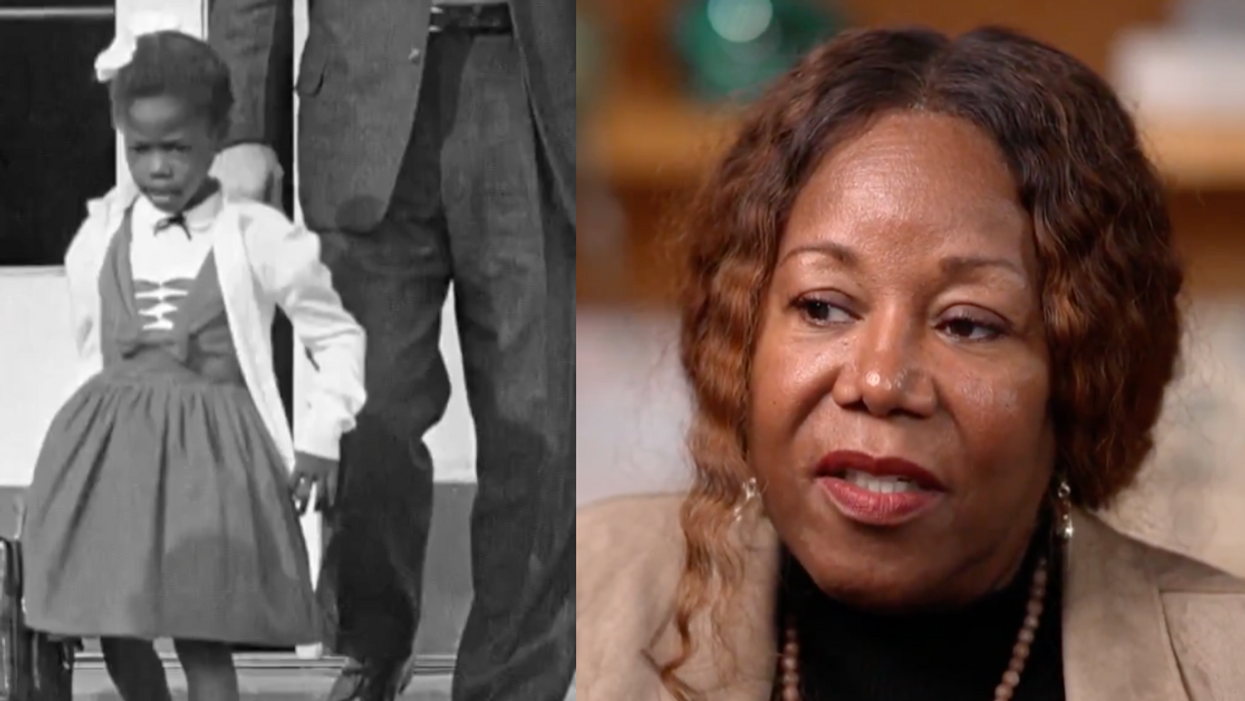
Civil rights activist Ruby Bridges is a crucial figure in U.S. history as the first Black child to integrate a Southern elementary school. However, right-wing culture warriors targeting books about American history, including systemic racism and discrimination against LGBTQ people, are trying to infringe on her legacy.
Books recounting Bridges’ story, including some written by Bridges herself, have faced bans or challenges in schools across several states, such as Pennsylvania, Texas, Iowa, and Tennessee. In 2022, a Florida school stopped showing a Disney film about Bridges' life after a parent claimed it could lead students to believe that white people dislike Black people.
In an interview with Meet the Press, Bridges told moderator Kristen Welker that these efforts are “ridiculous” and voiced her disagreement with the notion that her story makes white children feel guilty.
You can hear what Bridges said in the video below.
False claims that schools have been teaching critical race theory to young children have inflamed hostilities among the right wing, particularly since the publication of The 1619 Project, which repositions the consequences and legacy of slavery as elements vital to the historical narrative.
Critical race theory is a body of legal and academic scholarship that aims to examine how racism and disparate racial outcomes have shaped public policy via often implicit social and institutional dynamics.
Although critical race theory is just one branch of an incredibly varied arena of academic scholarship, it has nonetheless galvanized critics and threatened to obfuscate nationwide discussions about racial reconciliation, equity, and justice.
To that end, Bridges said these bans are an effort to "cover up history":
"I think that's ridiculous."
“Most of my books have been banned. The excuse that I’ve heard them give is that my story actually makes, especially white kids, feel bad about themselves. My biggest fans are kids all around the world, as I just mentioned, all of the letters [she gets] in the mail."
"I have little girls from all walks of life, different nationalities, that dress up like Ruby Bridges. I found through my 25 years of travel that they resonate with the loneliness, probably the pain that I felt, not having a friend."
“There’s all sorts of reasons that they’re drawn to my story. So I would have to disagree…I believe that it’s just an excuse not to share the truth—to cover up history. I believe that history is sacred—that none of us should have the right to change or alter history in any way.”
Bridges also discussed her experience as the first Black child to attend the formerly all-white William Frantz Elementary School in Louisiana during the New Orleans school desegregation crisis on November 14, 1960.
Bridges was born during the Civil Rights Movement, shortly after the landmark Brown v. Board of Education ruling that struck down the segregation of public schools.
The decision, issued mere months before her birth, declared that separate public schools for white and Black students were unconstitutional and ordered desegregation. Despite the 1954 ruling, southern states resisted integration for years, and state governments often failed to enforce the new laws.
Bridges initially attended a segregated kindergarten but in early 1960, she was one of six Black children in New Orleans to pass a test allowing them to attend the all-white William Frantz Elementary School. While two children opted not to transfer, the other four, including Bridges, did.
Bridges and the other children were escorted by federal marshals. In the days that followed, the marshals continued to accompany them. As soon as Bridges entered the school, white parents withdrew their children, and Bridges faced death threats.
Bridges told Welker she didn't fully grasp the importance of the moment because her parents didn't explain its significance to her at the time:
“My parents never explained to me what I was about to venture into. The only thing they said is, ‘Ruby, you’re going to go to a new school today, and you better behave.’ And living in New Orleans and being accustomed to Mardi Gras, I mean, you know, we see that during Mardi Gras. Huge crowds screaming and yelling."
"I often say what protected me was the innocence of a child. I thought that day I was venturing into a Mardi Gras parade. So I wasn’t afraid. It took a while before I really found out that the crowds were out there for me. And that happened when I finally had an opportunity to meet another child.”
You can hear what she said in the video below.
Many appreciated Bridges—a living icon of the fight for racial justice—for speaking out.
The GOP-led effort to ban books has garnered significant national attention and libraries have emerged as a major flashpoint among hard-line Republicans who've pushed back against literature they've deemed "subversive."
Typically, legislators initiate book bans as their first step. If these bans don't yield the desired results, they often escalate to threats of defunding local libraries. This pattern tends to emerge in states where lawmakers seek to restrict healthcare access for transgender individuals, limit drag performances, and regulate discussions on gender, sexuality, race, and history in schools.
Over time, certain factions within the GOP have increasingly resorted to drastic measures in the name of censorship, resulting in significant setbacks for libraries nationwide.
Advocates for library closures often cite concerns about "inappropriate topics" for children and make unsubstantiated claims about schools indoctrinating or "grooming" children with leftist ideologies.

 @gwenstefani/Instagram
 @gwenstefani/Instagram
 @gwenstefani/Instagram
 @gwenstefani/Instagram
 @gwenstefani/Instagram
 @gwenstefani/Instagram
 @gwenstefani/Instagram
 @gwenstefani/Instagram
 @gwenstefani/Instagram
 @gwenstefani/Instagram
 @gwenstefani/Instagram
 @gwenstefani/Instagram
 @gwenstefani/Instagram
 @gwenstefani/Instagram
 @gwenstefani/Instagram
 @gwenstefani/Instagram
 @gwenstefani/Instagram
 @gwenstefani/Instagram
 @gwenstefani/Instagram
 @gwenstefani/Instagram
 @gwenstefani/Instagram
 @gwenstefani/Instagram
 @gwenstefani/Instagram
 @gwenstefani/Instagram
 @gwenstefani/Instagram
 @gwenstefani/Instagram
 @gwenstefani/Instagram
 @gwenstefani/Instagram
 @gwenstefani/Instagram
 @gwenstefani/Instagram
 @gwenstefani/Instagram