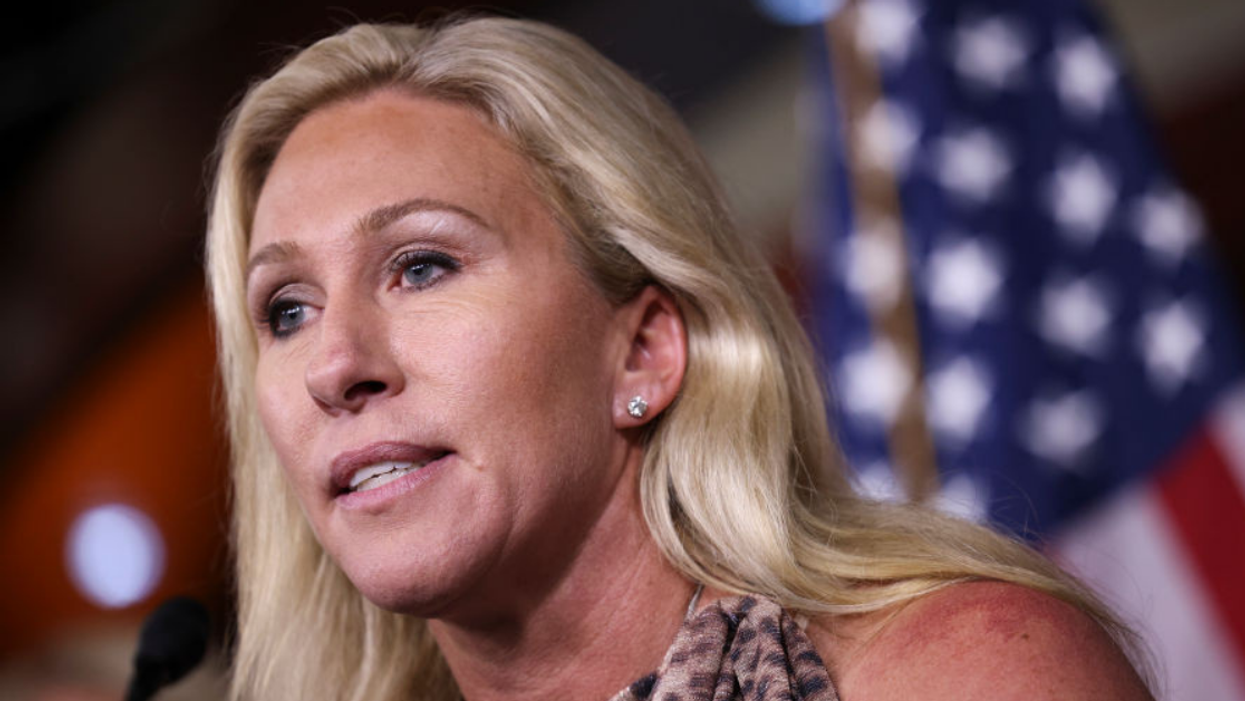

Georgia Republican Representative Marjorie Taylor Greene claimed the Declaration of Independence offers a justification for the January 6 insurrection.
Greene made the claim during an appearance on "War Room," a podcast hosted by former President Donald Trump's ex-chief strategist Steve Bannon.
Her remarks are only her latest attempt to rewrite the narrative of the attack, which took place when a mob of the former President's supporters stormed the United States Capitol on the false premise that the 2020 election had been stolen.
You can hear them in the video below.
Marjorie Taylor Greene says "January 6 was just a riot at the Capitol" and media outlets "would do anything to cause someone like me to be killed." pic.twitter.com/YSUqRAnEy4
— David Edwards (@DavidEdwards) October 26, 2021
Greene claimed that independent voters "need to look harder at the lies of 'BlueAnon'," a derogatory nickname for critics who have criticized her own affinity for QAnon conspiracy theories, adding:
"BlueAnon, the dangerous media, the Democrat media that is so divisive and would do anything that would cause someone like me to be killed or someone like you, Steve, to be killed because of the Democrat lies about us and about January 6."
"You see, they're the real problem in the country and I hope that these independent voters, these people that are starting to wake up, I hope that they wake up to these lies, because they're telling terrible things about us, things that are not true, and things about other Republicans that are not true and innocent people that were at the Capitol on January 6."
She then pivoted, asserting that the Declaration of Independence offers clear justifications for the attack, which she claimed was designed to quell what she referred to as a "Communist revolution":
"But the real truth is the Communist revolution that the Democrats funded and waged every single day and every single night in American cities around the country."
"You see, that was an attack on innocent American people whereas January 6 was just a riot at the Capitol."
"If you think about what our Declaration of Independence says, it says to overthrow tyrants. There is a clear difference between January 6 and the Marxist, Communist revolution, the Antifa, BLM, Democrat ground troops waged on the American people in 2020."
"But the selfish, self-righteous Congress that only serves itself refuses to talk about the people. All they want to talk about is the riot on January 6 and I'm fed up with it, I'm sick of it, and I'm tired of their lies."
Greene's claims about the Declaration of Independence are misleading.
While the Declaration certainly takes a long celebrated stance against tyranny, the right to revolution enshrined in the document is specifically in reference to the reasons why the original thirteen colonies at war with Great Britian were asserting their independence as independent, sovereign states.
The Declaration asserts, along with the right to revolution, certain natural and legal rights. It says, for instance, that the only legitimate governments are those that have the consent of the governed.
And when a government ceases to defend the human rights of its people, the people have the ability to withdraw their consent and set up a new government that better serves their interests.
However, Greene has failed to acknowledge that the storming of the U.S. Capitol was an attack against the seat of U.S. government spurred by a falsehood: former President Trump's insistence that the election was not free and fair.
In fact, a statement from the Trump administration's own Cybersecurity & Infrastructure Security Agency (CISA), part of a joint statement from the Election Infrastructure Government Coordinating Council and the Election Infrastructure Sector Coordinating Executive Committees, affirmed the agencies found "no evidence that any voting system deleted or lost votes, changed votes, or was in any way compromised."
Greene has been widely criticized for her remarks.
The context of her comment is even worse. She says the protests in the wake of Floyd's murder were a "communist revolution" funded by Democrats, and that January 6th was "just a riot" aimed at overthrowing tyrants. https://t.co/fRwHoyZTgS
— Kyle Baxter (@kbaxter) October 27, 2021
1) Disingenuous @GOP's love to talk out of both sides of their neck re: #January6th. When they're on a mainstream media platform either the "January 6th was Antifa" level horseshit gets carted out or they act like it was some anomaly committed by a few overzealous bad apples.-> https://t.co/nBPDFzHAN2
— Johnny Spade (@WhatSpadeThinks) October 27, 2021
Take a good look kids, a great example of people who uses words they don't understand.@GOP @DNC @JusticeOIG come and get your girl. https://t.co/KcWyOWcrok
— Moses Rodrigues (@MosestheActor) October 27, 2021
@MajorieTaylorGreene WAS THERE Or at a minimum watching it on TV with #Trump LAUGHING! She is a law breaker and NEEDS TO BE GONE! https://t.co/iTojr5bePP
— Donna - #Resist #NoDM's (@DRyan327) October 27, 2021
@RepMTG is crazy as a damn loon! 🤦🏼♀️
What's wrong crazy girl, you're sounding a little paranoid! Scared that your lies are going to catch up with you? #Jan6Insurrection #Jan6Committee https://t.co/KgUQ35JFml
— Tammy Smith (@ingirl388) October 27, 2021
She does not deserve the title she holds https://t.co/9AZL342aIv
— Barbara Othmer (@OthmerBarbara) October 27, 2021
I don't think anyone would throw away their freedom to kill her. She's not worth a bent penny, let alone that. She's doing herself in with the constant stream of lies coming out of her mouth. Keep it up @mtg you're just digging your political grave with every lie. https://t.co/Q0v7KN7pEH
— LittleS (@LittleS61138811) October 26, 2021
She has swayed Independent voters. I am and I now will do ANYTHING to keep GOP (not conservative Republicans) candidates as far away from power as possible. How these weirdos have driven from the truth? BLM was a Civil Rights event by THE PEOPLE. Jan 6th was an embarrassment https://t.co/OMtYQPje9L
— Spanky Gorey (@TankVF) October 26, 2021
Greene's statements are also a misconstruing of American history.
Truth be told, the United States Constitution goes to greater lengths to protect personal liberty from the tyranny of big government.
At the heart of the disagreements between the nation's Framers was whether the United States should embrace a federalist system.
Federalism refers to a compound form of government that mixes elements of a central government with lower level governments into a single political system.
Federalists wanted to ratify the Constitution and supported stronger national governments. Antifederalists opposed ratification and preferred power to be concentrated in the states themselves.
At the core of the Antifederalist arguments was the fear of tyranny from politicians, which set up what James Madison in Federalist No.10 identified as factions, which he describes as
"a number of citizens, whether amounting to a majority or minority of the whole, who are united and actuated by some common impulse of passion, or of interest, adverse to the rights of other citizens, or to the permanent and aggregate interests of the community."
The Antifederalists also wanted explicit protections of individual liberties and demanded the Constitution include explicit assurances against tyranny, an issue Madison criticized because the Constitution does not explicitly grant powers to the government that could be perceived to violate rights.
Madison was eventually persuaded by Thomas Jefferson that individual rights should not be "left to inference," and agreed to include a Bill of Rights, which became the Constitution's first ten amendments.
This move pleased Antifederalists like George Mason, who in his "Objections to the Constitution" lamented that "the Laws of the general Government being paramount to the Laws & Constitution of the several States, the Declarations of Rights in the separate States are no Security."



 Liam McBurney/PA Images via Getty Images
 @MysterySolvents/X
 @Bill43111/X
 @liberalpuppy/X



 @realDonaldTrump/Truth Social