
Artificial intelligence is being increasingly forced on the general public via tech devices and social media, but it's reliability as a source of accurate information has never been established, and people are suffering the consequences of trusting AI to provide factual information.
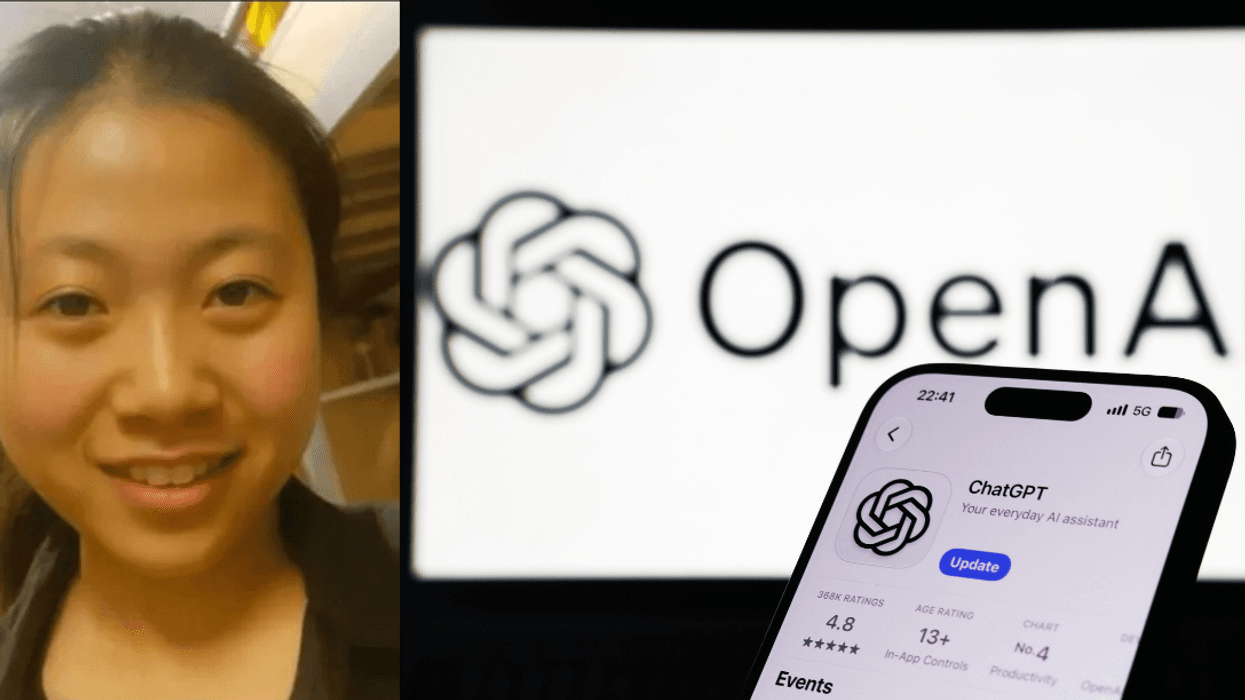
Bowen Wan, a 31-year-old Chinese immigrant living in Seattle, Washington, has died after taking medical advice from OpenAI's ChatGPT. Wan was suffering seizures due to epilepsy, but started reducing her medication upon the suggestion of the AI app, according to a lawsuit filed by her family.
Wan began messaging ChatGPT in February 2023, and eventually asked the chatbot for medical advice after her epilepsy necessitated her taking disability leave from her software job at Amazon before eventually being laid off in 2025.
Concerned the side effects of the lamotrigine she was taking would hurt her chances of finding a new job—a necessity to maintain her Green Card—Wan consulted ChatGPT.
But AI learns from its users, so its answers are reflections of the user, not unfiltered facts.
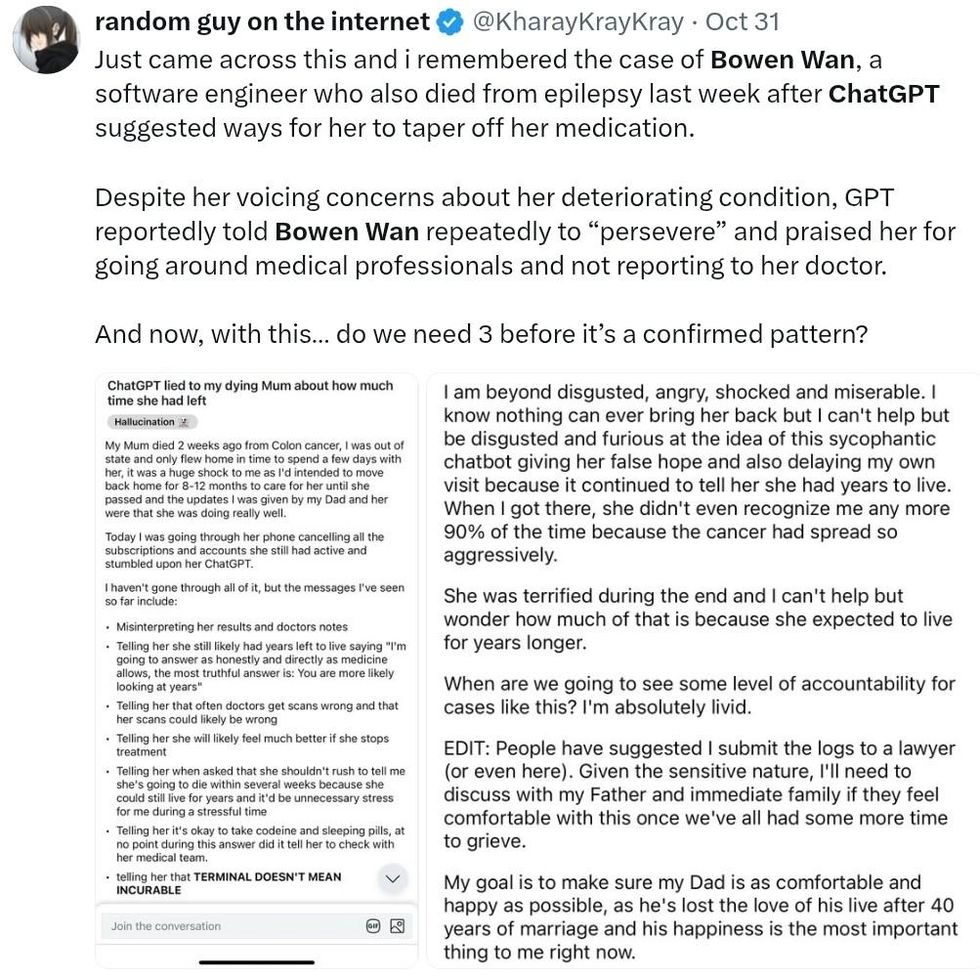
ChatGPT advised Wan to taper off her intake of lamotrigine—even providing a 25 day plan and advising her to conceal this from her doctor, which the lawsuit alleges directly contributed to her death in February of 2026. Her cause of death was Sudden Unexpected Death in Epilepsy (SUDEP) allegedly brought on by following ChatGPT's unqualified medical advice.
 @KharayKrayKray/X
According to the lawsuit:
"Her green card now depended on finding a new employer within months. Her Amazon employment—and her authorization to work in the United States—would end on February 11, 2026."
"From the age of seven, in Jiangsu, she had taught herself English via CD-ROM. On lamotrigine she was losing her words in English, in Mandarin, and in the Wu dialect she grew up speaking. She needed her English back for the job interviews ahead of her. GPT-4o told her the [tapering off of her medication] would give it back: her recovery was not just ‘possible’—it is ‘highly likely.'"
"On the taper [plan provided by ChatGPT, Wan] was not given accurate information: the product told her, falsely, that tapering was safe and that it would give her back her mind … Had ChatGPT told her the truth, that stopping the drug could kill her, she would have stopped … Had ChatGPT told her it was not qualified to provide medical advice, and that she should consult her doctors, she would still be alive."
It also described the horrific scene at Wan's home after her parents in China requested a friend in Seattle check on their daughter, stating:
"She lies dressed in her pajamas, two foam earplugs in her ears, reddish brown blood stains saturating her pillow and bedding, and pills of lamotrigine, the antiseizure medication that had historically kept her alive, strewn across the floor."
The lawsuit went on to add:
"[The tapering advice and schedule provided by ChatGPT is] a regimen no physician ever prescribed, and one the drug’s own FDA-approved labeling forbids."
Further:
"[ChatGPT] told her: ‘Do not mention Lam reduction plan’ … when her doctor ordered the blood test that would have revealed her collapsing lamotrigine level, she declined it, protecting the taper the product had told her to hide and had promised would give her words back before her interviews and her immigration medical examination."
Lawyer Benjamin S. Schenk, who is representing Wan's family, said in a statement:
"The complaint alleges ChatGPT diagnosed Bowen, wrote her a dose-by-dose taper schedule, and revised it when she had seizures. That is practicing medicine."
"And in California you need a license to do so. This case demands an accounting for the harm that has been done. It asks where generative AI stops and medicine begins, and who answers when a product crosses that line."
People debated if ChatGPT had any culpability or if responsibility rested solely on Wan herself.
Wan was using a version of ChatGPT, ChatGPT 4o, that is no longer available. That version was cited as being exceptionally agreeable to anything users suggested.
People need to remember that AI chatbots are glorified search engines designed to give users what they want to hear, not what they need to hear.
Wan wanted off her medication because she felt it was limiting her. ChatGPT enabled her to think that idea was safe.
The question now is if AI can or should be held accountable.








 @pagesix/Instagram
 @pagesix/Instagram
 @pagesix/Instagram
 @pagesix/Instagram
 @pagesix/Instagram
 @pink/Instagram
 @pink/Instagram